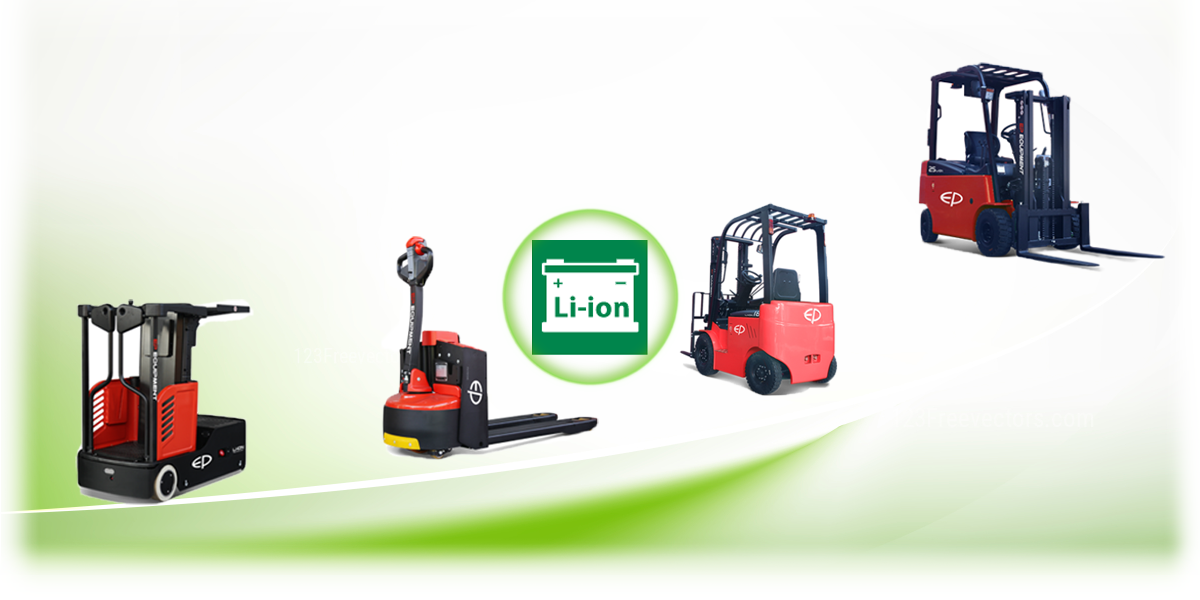
Lithium-ion battery technology provides sustainable changes in the transformation of our way of storing and consuming energy.
Lithium-ion batteries are widely used in the manufacture of electric trucks. They became popular mainly among pallet trucks due to the introduction of EPT-12EZ by EP Equipment in 2016. Since then, the original pallet trucks have been manufactured mainly with Li-Ion batteries, although the technology used can vary considerably with each machine, which leads to different safety features and standards.
- Why are lithium-ion batteries getting more attention in today's market?
- Where are the differences between traditional lead-acid batteries and the latest innovations in Li-Ion technology?
- What are the different types of Li-Ion batteries? Are they safe? Are they expensive?
WHY CHOOSE LITHIUM-ION BATTERIES INSTEAD OF LEAD-ACID BATTERIES?
In the past, these electric machines were powered by some kind of lead-acid battery or AGM battery. In recent years, Li-Ion has become increasingly cost-effective as it plays a stronger role in manufacturers 'and customers' purchasing and development strategies. When you look at the prices of pallet trucks nowadays, it seems logical to stop at the Li-Ion version, even with the ride-on versions, as it offers huge advantages.
When purchasing products with a lithium-ion battery, the following features stand out:
Longer service life
Lithium-ion batteries typically last several times the number of cycles of lead-acid batteries, leading to a longer effective life of lithium-ion products. Cycles are also counted as a percentage of charge, not when connecting the battery to the charger. This means: 10% charge is 1/10 of the cycle with a Li-Ion battery, while 10% charge of a lead-acid battery is 1 full cycle. When the lead-acid battery is not fully charged, its life is shortened several times.
Possibility for faster charging
While lead-acid batteries always need a full charge cycle of 8-12 hours, LI-Ion batteries can be charged in 10 minutes during a lunch break. This offers exceptional convenience for your work shifts.
Less weight
Lithium-ion batteries offer high power density, which makes them relatively small and light. They are one third of the weight of lead-acid batteries. This offers manufacturers the opportunity to develop products with higher standards of ergonomics, more legroom for the operator and greater efficiency due to the smaller size and weight of the batteries.
Higher efficiency
Most lithium-ion batteries have 95% efficiency or more, which means that 95% or more of the energy stored in a lithium-ion battery can actually be used. The opposite is true for lead-acid batteries with an efficiency of 80-85%.
More environmentally friendly
From an environmental point of view, these batteries are non-toxic, harmless and do not emit gas. Therefore, this technology is much cleaner and safer for the environment as well as for your employees.
No maintenance required!
While lead-acid batteries require special maintenance, lithium-ion batteries do not require such to extend their service life. This largely eliminates the cost of maintaining the batteries.
ARE ALL LITHIUM-ION BATTERIES THE SAME?
There are several types of chemical components for building lithium-ion rechargeable batteries. The two most important materials are lithium iron phosphate (LFP) and lithium nickel manganese cobalt oxide (NMC). NMC technology is very well known in the automotive industry and other industries, where weight and size play an important role. The advantage of NMC batteries is high energy density and compact size. The disadvantage is the high possibility of swelling and explosion when overheated.
EP Equipment manufactures all its products with Li-Ion technology with LFP batteries, as Li-phosphate is more tolerant to full charge conditions and has less voltage.
HOW TO CHOOSE THE RIGHT LITHIUM-ION BATTERY FOR YOUR EQUIPMENT?
When considering replacing a lead-acid battery with a lithium-ion battery, there are a few things to keep in mind:
High quality battery cells
The cell is the heart of the battery. EP uses only the highest quality cells from the safest technology and strives to improve energy density and power to extend service life. EP accepts LiFePO4 cells that can operate over a wide temperature range for a variety of applications, even in extreme weather conditions.
Reliable BMS system
Battery management systems (BMS) play a crucial role in protecting the battery against short circuit, reverse polarity, low or high voltage. BMS ensures battery life and improves performance.
Lithium-ion batteries are known to ignite when overheated, especially during charging. A good charger is not enough, and to prevent this, the BMS communicates with the battery, the machine and the charger, constantly monitoring the temperature. The system is switched on when the temperature is outside the permissible range. It also protects the battery from overheating during charging.
Stable Can Bus system
The Can Bus system allows the connection between all parts of the battery. The Can Bus system provides battery status information and automatically sends alarms to the BMS system when damage occurs.
Take a look at our wide range of products with lithium-ion technology.